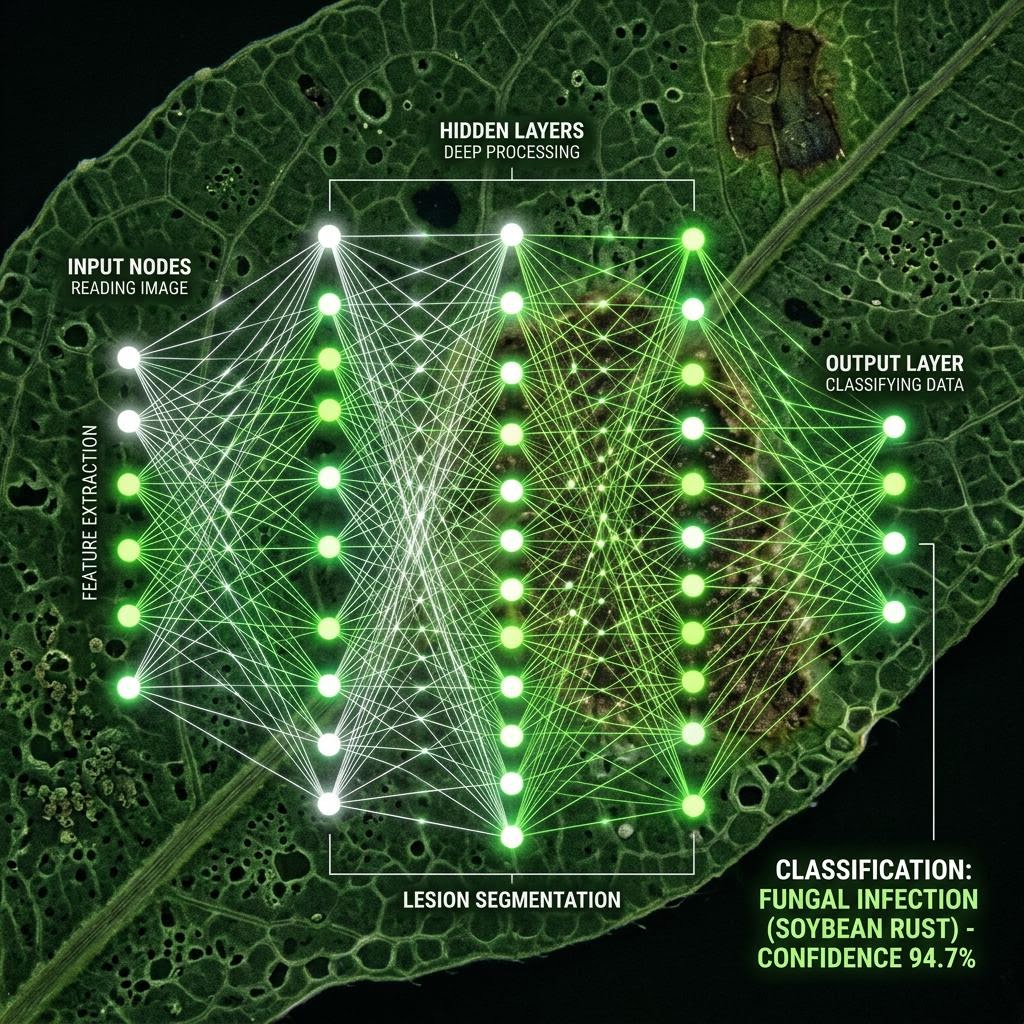
6 Specialized AI/ML Models
Disease/Pest Classifier
Technique: CNN (EfficientNet)
Transfer learning on labeled regional crop datasets identifies specific disease or pest types directly from high-resolution canopy imagery.
Lesion Segmentation
Technique: U-Net / Mask R-CNN
Semantic segmentation maps the exact affected area within a field for highly accurate severity scoring and boundary definition.
Stress Index Estimator
Technique: NDVI/NDRE + Regression
Multispectral index modeling combined with regression detects water and nutrient stress early by analyzing non-visible light spectrums.
Spread Forecaster
Technique: Spatiotemporal Modeling
Combines micro-weather data (wind, humidity) and detection history to predict exactly how fast and in what direction an issue will spread.
Yield Predictor
Technique: Gradient-Boosted Trees
Fuses imagery data, historical performance, and current stress levels to forecast final harvest yield under current interventions.
Prescription Engine
Technique: Rule-Based Logic
Translates complex model outputs into standardized variable-rate prescription maps validated by expert agronomists.